Vector Spaces
A vector space (or subspace) is the set of all linear combinations of a collection of vectors — every vector you can form by scaling and adding the generators together.
In panchi, VectorSpace is a slim container: it holds the spanning set and validates it, nothing more. The derived structure — basis, rank, membership, complements — is computed on demand by free functions in panchi.algorithms:
from panchi import Vector, VectorSpace
from panchi.algorithms import (
    basis,
    rank,
    is_full_rank,
    contains,
    same_subspace,
    orthogonal_complement,
    span,
    standard_basis,
    column_space,
    row_space,
    null_space,
)
This mirrors the rest of the library, where the heavy operations (solve, inverse, determinant_lu) are functions rather than methods. It keeps the primitive lightweight and the layering clean.
Construction
v1 = Vector([1, 0, 0])
v2 = Vector([0, 1, 0])
v3 = Vector([1, 1, 0])  # linearly dependent on v1 and v2

vs = VectorSpace([v1, v2, v3])
The spanning set is stored as provided. All vectors must be Vector instances with the same number of components. Passing a non-Vector, an empty list, or vectors of mixed dimensions raises an informative error:
VectorSpace([])                             # ValueError — no subspace defined
VectorSpace([Vector([1, 2]), [3, 4]])       # TypeError — list is not a Vector
VectorSpace([Vector([1, 2]), Vector([1])])  # ValueError — dimension mismatch
Basis
basis(space) returns a maximal linearly independent subset of the spanning set — the vectors that actually define the subspace, with all redundant generators removed.
vs = VectorSpace([Vector([1, 0]), Vector([0, 1]), Vector([1, 1])])
basis(vs)  # [Vector([1, 0]), Vector([0, 1])]
The basis is computed by forming a matrix whose columns are the spanning vectors, reducing it to row echelon form, and returning the original vectors at the pivot columns. The result is always drawn from the original spanning set in the original order.
If the entire spanning set is linearly independent, basis returns all of them unchanged:
vs = VectorSpace([Vector([1, 0, 0]), Vector([0, 1, 0]), Vector([0, 0, 1])])
len(basis(vs))  # 3
Rank (dimension of the span)
rank(space) is the dimension of the subspace — the number of vectors in a basis, or equivalently the rank of the spanning set. The teachable identity is rank(vs) == len(basis(vs)).
vs = VectorSpace([Vector([1, 0]), Vector([0, 1]), Vector([1, 1])])
rank(vs)  # 2
The operation is named rank, not "dimension", on purpose. A space carries two distinct notions of "dimension", and reusing the word invites confusion:
rank(vs)counts independent directions — the size of the span.vs.ambient_dimscounts components — the n in Rⁿ that the space lives inside (the same quantity a singleVector.dimsreports).
The rank is always less than or equal to the number of spanning vectors:
len(vs)   # 3 — number of generators
rank(vs)  # 2 — independent directions
Rank has a geometric meaning: a rank-1 span is a line through the origin, while a rank-2 span fills the whole plane. Animator2D.plot_span shades the region a set of vectors covers:
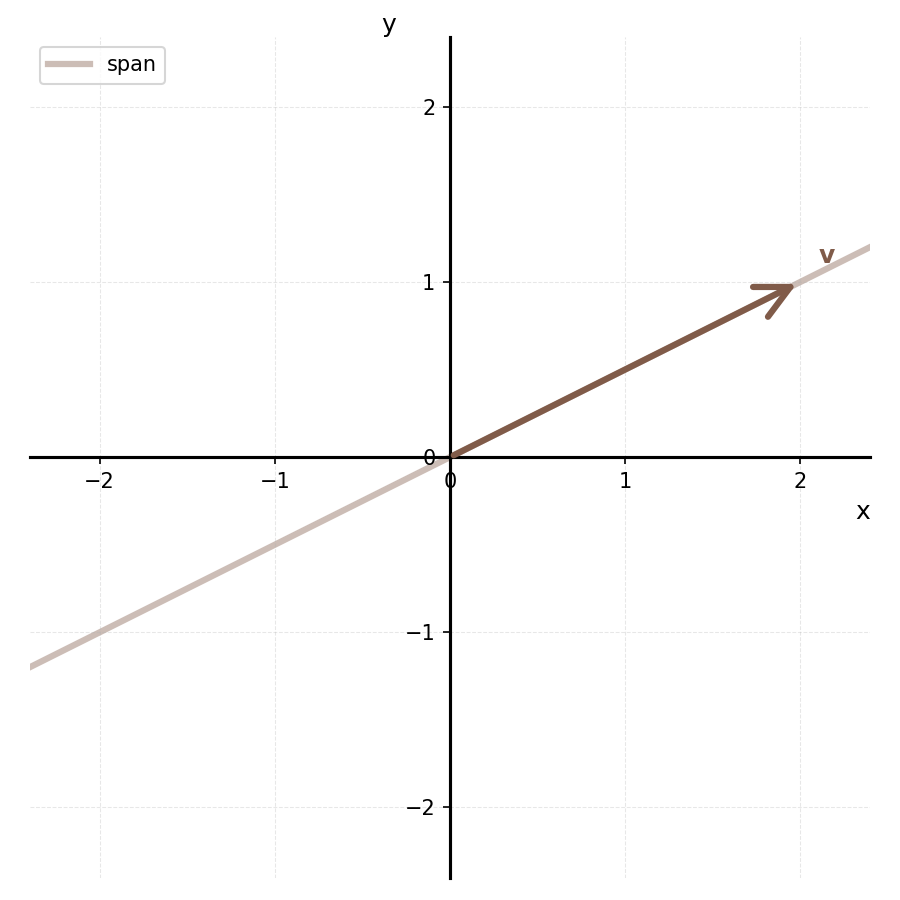
plot_span([Vector([2, 1])]).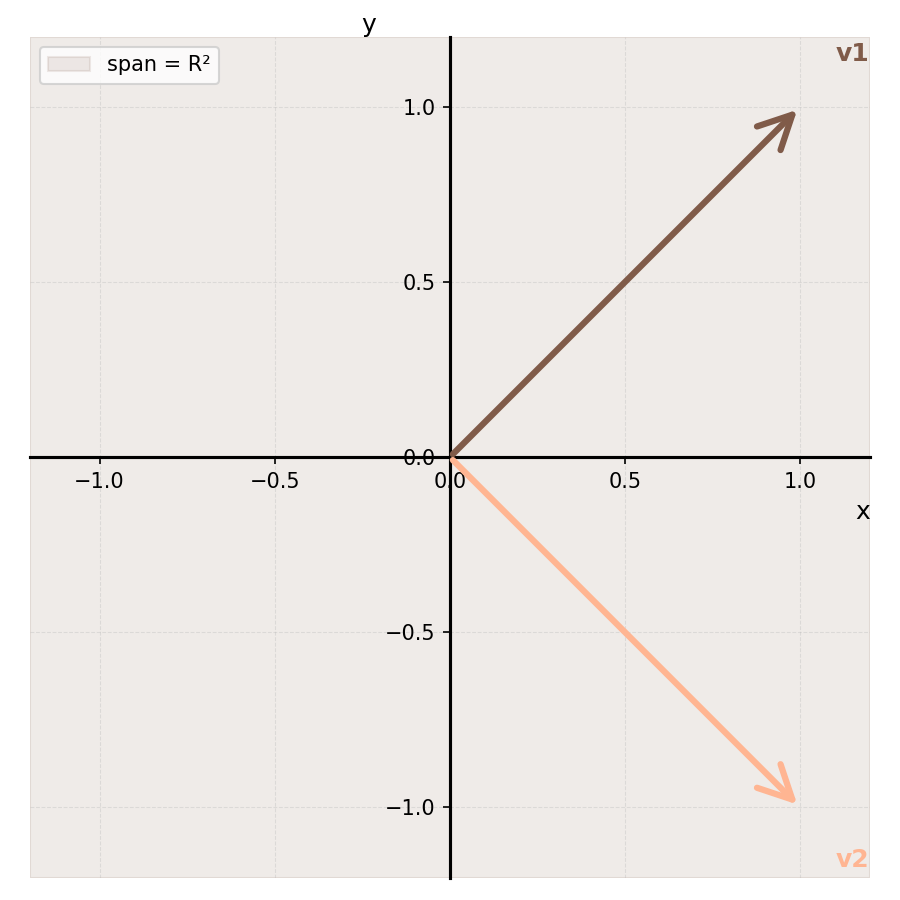
plot_span(VectorSpace([Vector([1, 1]), Vector([1, -1])])).Ambient dimension
ambient_dims is a property on the space itself — it is intrinsic to the container (just the component count) and needs no computation, so it stays on VectorSpace. It returns the n in Rⁿ, independent of how many generators the space was given.
vs = VectorSpace([Vector([1, 0, 0]), Vector([0, 1, 0])])
vs.ambient_dims  # 3  — the space lives inside R³
rank(vs)         # 2  — the subspace itself is 2-dimensional
Full rank
is_full_rank(space) returns True when the subspace spans all of Rⁿ, i.e. when rank(space) == space.ambient_dims.
is_full_rank(VectorSpace([Vector([1, 0]), Vector([0, 1])]))        # True  — spans R²
is_full_rank(VectorSpace([Vector([1, 0, 0]), Vector([0, 1, 0])]))  # False — plane in R³
Indexing and iteration
The generating set is indexable and iterable, just like Vector and Matrix:
vs = VectorSpace([Vector([1, 0]), Vector([0, 1])])

vs[0]    # Vector([1, 0])
vs[-1]   # Vector([0, 1])
len(vs)  # 2

for v in vs:
    print(v)
# [1, 0]
# [0, 1]
You can replace a spanning vector by index. The replacement must be a Vector with the same number of components as the rest of the space:
vs[0] = Vector([2, 0])     # valid — same dimension
vs[0] = Vector([1, 0, 0])  # ValueError — wrong number of components
vs[0] = [2, 0]             # TypeError — not a Vector
Because basis and rank are computed on each call (nothing is cached on the container), they always reflect the current generating set after such an edit.
Equality
Two VectorSpace objects are equal if their generating sets contain the same vectors, regardless of order:
v1, v2 = Vector([1, 0]), Vector([0, 1])

VectorSpace([v1, v2]) == VectorSpace([v1, v2])  # True
VectorSpace([v1, v2]) == VectorSpace([v2, v1])  # True — order does not matter
Membership testing
contains(space, v) returns True if vector v lies in the subspace. It solves the system Bx = v where B is the matrix of basis vectors, and reports whether the system is consistent.
vs = VectorSpace([Vector([1, 0]), Vector([0, 1])])
contains(vs, Vector([3, 4]))   # True  — any R² vector is in the full plane

vs2 = VectorSpace([Vector([1, 0, 0]), Vector([0, 1, 0])])
contains(vs2, Vector([0, 0, 1]))  # False — z-axis is out of the xy-plane
Passing a non-Vector or a vector of the wrong dimension raises an error:
contains(vs, [1, 0])               # TypeError — argument must be a Vector
contains(vs, Vector([1, 0, 0]))    # ValueError — wrong number of components
Subspace equality
The == operator checks whether two VectorSpace objects were built with the same generators (order-independent). For a mathematical comparison — do the two spaces span the same subspace? — use same_subspace:
v1, v2 = Vector([1, 0]), Vector([0, 1])

vs1 = VectorSpace([v1, v2])
vs2 = VectorSpace([v1, v1 + v2])

vs1 == vs2                  # False — different generators
same_subspace(vs1, vs2)    # True  — both span all of R²
Two subspaces are equal when they have the same rank and every basis vector of one is contained in the other — which is exactly what same_subspace checks:
vs3 = VectorSpace([Vector([1, 0, 0]), Vector([0, 1, 0])])
vs4 = VectorSpace([Vector([1, 1, 0]), Vector([1, -1, 0])])
same_subspace(vs3, vs4)  # True — both span the xy-plane in R³
Comparing spaces of different ambient dimensions raises an error:
vs_r2 = VectorSpace([Vector([1, 0])])
vs_r3 = VectorSpace([Vector([1, 0, 0])])
same_subspace(vs_r2, vs_r3)  # ValueError — different ambient dimensions
Constructing subspaces
Rather than assembling spaces by hand, panchi provides the textbook constructors. span is a
readable alias for the constructor, and standard_basis(n) builds all of Rⁿ:
span([Vector([1, 0]), Vector([0, 1])])   # VectorSpace(ambient=2, generators=2)
rank(standard_basis(3))                   # 3 — the standard basis spans R³
The three fundamental subspaces of a matrix are one call each. The column_space (the span of the
columns) and row_space both have dimension rank(A); the null_space (the kernel) has dimension
nullity(A):
A = Matrix([[1, 2, 3], [4, 5, 6]])

rank(column_space(A))   # 2 == rank(A)
rank(row_space(A))      # 2 == rank(A)
rank(null_space(A))     # 1 == nullity(A)

# every null-space vector is annihilated by A
all(A @ v == Vector([0, 0]) for v in null_space(A))  # True
When A has full column rank the null space is trivial — represented by the zero vector (rank 0).
Orthogonal complement
The orthogonal complement of a subspace W is the set of all vectors perpendicular to every vector in W:
vs = VectorSpace([Vector([1, 0, 0]), Vector([0, 1, 0])])
comp = orthogonal_complement(vs)
print(comp)
# VectorSpace in R^3, spanned by 1 vector:
#   [0, 0, 1]
The complement satisfies the rank–nullity relationship: rank(comp) + rank(vs) == vs.ambient_dims.
For a line in R²:
vs = VectorSpace([Vector([1, 1])])
comp = orthogonal_complement(vs)
basis(comp)  # [Vector([-1, 1])]  — perpendicular to [1, 1]
If the space spans all of Rⁿ, the complement is trivial (the zero vector):
vs = VectorSpace([Vector([1, 0]), Vector([0, 1])])
comp = orthogonal_complement(vs)
rank(comp)  # 0
String representation
str() shows the ambient dimension and the spanning set the space was built from:
vs = VectorSpace([Vector([1, 0, 0]), Vector([0, 1, 0]), Vector([1, 1, 0])])
print(vs)
# VectorSpace in R^3, spanned by 3 vectors:
#   [1, 0, 0]
#   [0, 1, 0]
#   [1, 1, 0]
repr() gives a compact summary:
repr(vs) # 'VectorSpace(ambient=3, generators=3)'
To see the reduced basis or the rank instead, call basis(vs) and rank(vs).